
Remarkable & Ordinary Courage
Reflections at the start of Black History Month

Good morning bread friends,
And welcome to another Black History Month in America.
Last week, I wrote about uplifting stories and shared links to encouraging news articles that told the story of ordinary people bravely protecting one another’s dignity and justice in Minneapolis. It was really meaningful to hear back from so many of you. A number of you replied to share that clicking through those stories brought you some genuine encouragement. Thank you for that feedback. I really appreciate it. I’m glad that it served as a reminder that even in hard times, there are unsung heroes all around us.
That’s exactly the spirit in which I shared that email… as encouragement for others, but also as encouragement for myself. A reminder that even in hard times there are plenty of examples (if we’re willing to look) of remarkable people doing remarkable things. And often, people’s bravery goes largely unremarked upon.
As we enter Black History Month, I’ve been thinking about that more deeply. We know the names of many heroes whose stories are rightly celebrated — but there are also countless people who lived courageous lives (or ordinary lives punctuated by heroic moments) whose stories history never fully tells.
I recently started reading a book that highlights that idea beautifully: Freedom’s Daughters by Lynne Olson
The first chapter opens with the story of Rev. Dr. Pauli Murray.
Pauli Murry is not the first Reverend Doctor that people think of when they think of the civil rights movement, but her name is not exactly lost to history either.
Her legacy as a lawyer, activist, scholar, and priest is honored at both the National Museum of African American History and Culture and the National Women’s History Museum.
What struck me most about her story wasn’t just who she became, but when she acted.
In 1943, when Pauli was a 31-year-old law student at Howard University, she joined a group of women to organize and carry out a successful sit-in at the Little Palace Cafeteria on U Street in Washington, D.C.
This was more than a decade before the sit-ins that most of us learn about, and well before there was an organized national infrastructure to support that kind of protest. They simply saw injustice and took action, doing the best they could with what they had.
Pauli Murray went on to be a remarkably influential American, but there were a few dozen women with her in that sit-in who’s courage was just as bold and consequential on that day
They didn’t go on to get their face on a quarter.
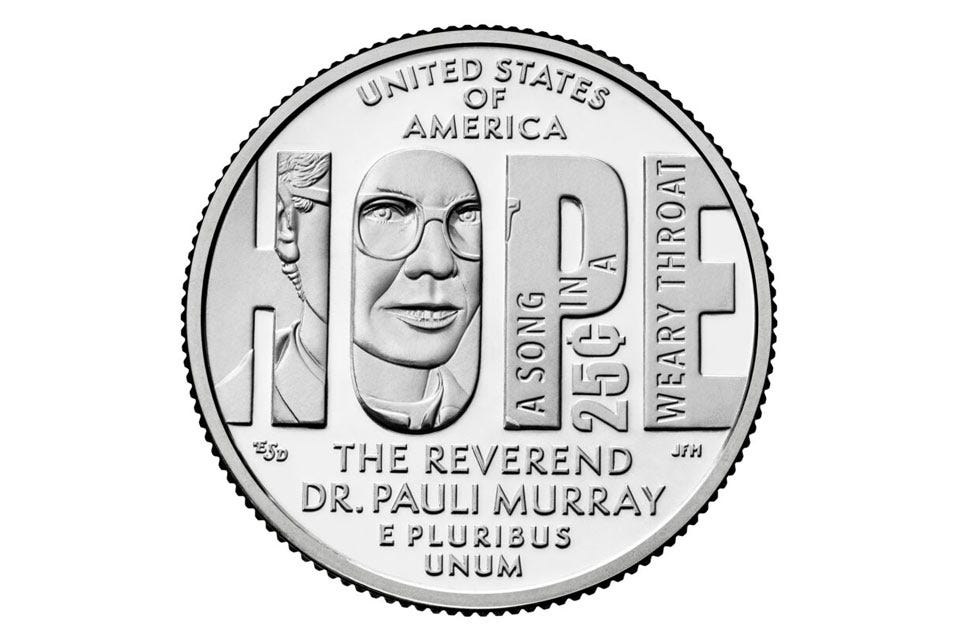
Yet, I’m just as inspired by those people’s bold courage on that day in 1943.
Anyway… the year is now 2026. We live in a country that formally celebrates Black history… and still struggles mightily to live up to its stated ideals of justice, equality, and even due process under the law.
But I find encouragement in the knowledge that we still have the same opportunity those women had in 1943. We have the opportunity to carry ourselves with dignity, to use our voices, and to live in ways that reflect our values… even (and especially) when doing so is uncomfortable or uncelebrated.
Cheers,
Mo
P.S. next week I’ll report out on our donations from January to Briarpatch.
P.P.S. For the month of February, we’ll be donating to Black Voters Matter. Black Voters Matter is the very first organization that Bread & Justice ever donated to back in 2020. With the recent threats from the President of the United States to nationalize elections in certain states… it is very present on my mind that the right to vote has not always been a universal right in this country. Nor is not a fact of nature that it always will. The people will have to continue to demand it.
P.P.P.S. If you read this far… why not go ahead and click through to order bread 🤗